Firewood, pellets, or a heat pump? Let’s see if it’s worth heating your home with biomass this winter, using real data from a LEFE system and a checklist to help you decide.
Winter is coming, and every year the same question comes up: gas, electricity, or firewood? Recently, a fourth option has been gaining ground in Portuguese homes: biomass and pellets for heating, whether in wood-burning stoves or automatic pellet boilers. But is it really worth switching? Let’s look at the actual numbers, without any empty promises.
Biomass is any fuel of organic origin: firewood, pellets (compressed sawdust), or briquettes. In practice, for a home in Portugal, this usually comes down to three options:
These are very different solutions in terms of day-to-day convenience, but they all share the same fundamental advantage: the fuel is domestically sourced (or European), cheaper per kWh than electricity in many scenarios, and not dependent on oil prices.
A 15-kg bag of pellets currently costs between €4 and €6 at major retailers, depending on the brand, about €0.30 to €0.40 per kilogram. When purchased in bulk (pallets of 60 bags), the price per kilogram drops slightly. This is not a fixed price: the pellet market has fluctuated with European demand, so it’s always worth checking the price before making a decision.
For an automatic boiler, consumption depends mainly on three factors:
A wood-burning stove works differently: if you have access to your own firewood or can get it at a low price, the cost per kWh can be even lower than that of pellets, but it requires more manual labor (stoking the fire, cleaning out ashes more frequently).
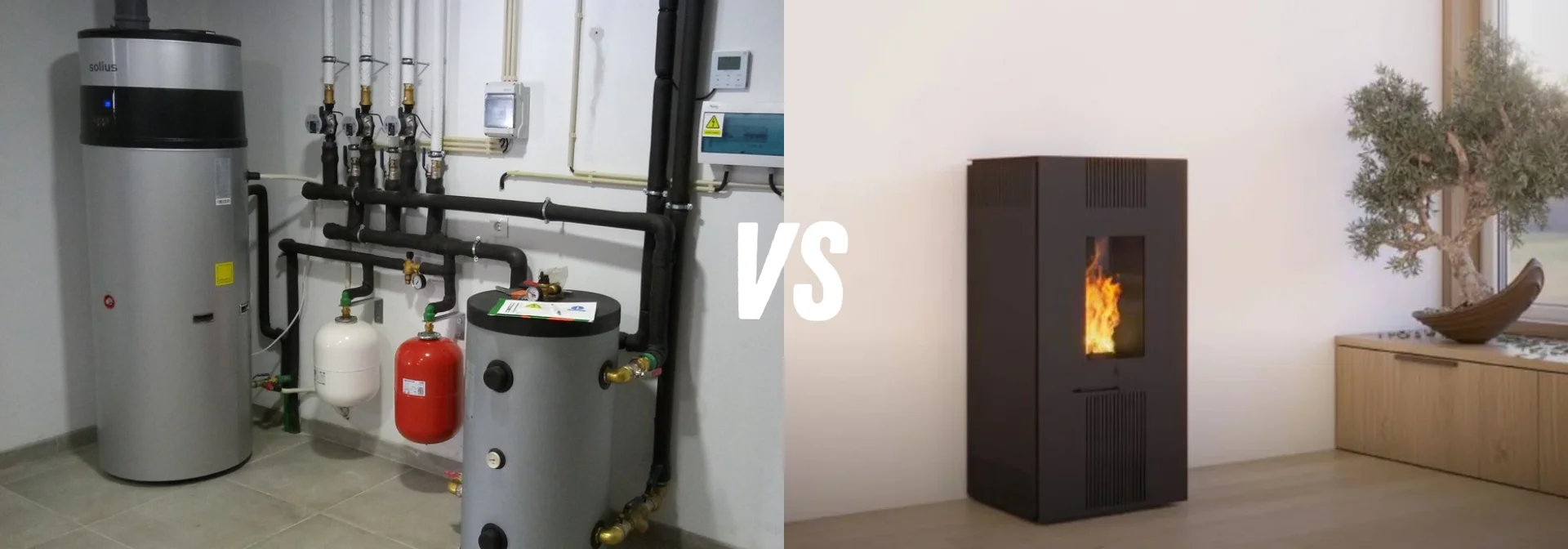
The most common question we hear at LEFE isn’t “firewood or pellets,” but rather “biomass or heat pump.” There’s no single answer: it depends on your usage profile.
| Criteria | Biomass boiler/stove | Heat pump |
|---|---|---|
| Efficiency | Efficiency up to ~90% (fuel combustion) | 3 to 5 kWh of heat per 1 kWh of electricity |
| Fuel cost | Pellets or firewood, more stable in the long term | Electricity, subject to the contracted rate |
| Irregular use (weekends, evenings) | Very flexible; starts and stops without losing efficiency | Loses efficiency when used only occasionally |
| Maintenance | Ash and chimney cleaning, annual inspection | Refrigerant and filter inspection |
| Initial investment | Medium to high (silo, flue piping) | Variable, generally lower for split-system models |
In practice, those who heat their entire home at set times and have access to a low-cost electricity rate tend to prefer heat pumps. Those who heat more irregularly, live in a cold part of the country, or already have access to firewood or pellets at a good price tend to prefer biomass. And there are even those who combine the two: a heat pump for everyday use and a wood-burning stove for the coldest days of the year.
In 2024, LEFE installed in a social housing building in the Famalicão area (name and address omitted for confidentiality) two Solius AutoPellets boilers, each with a capacity of 60 kW, featuring automatic burner and boiler body cleaning, automatic ash removal, and a 500-liter silo per unit. This is an institutional-scale installation, much larger than a residential one, but the figures are real and help illustrate the order of magnitude:
In a single-family home, the required power is much lower (typically between 15 and 30 kW, depending on the area and insulation), so the investment is proportionally lower. Even so, this example clearly illustrates what to expect from a certified automatic boiler: high efficiency, operation without daily intervention, and an investment that pays for itself over several winters of use.
If you answered “yes” to most of these questions, biomass is most likely an option worth seriously considering. If you answered “no” to most of them, it might be better to first look into a heat pump or improving your home’s insulation.
A common question is how much extra work biomass involves compared to a gas boiler or a heat pump. The honest answer is: some, but it’s manageable.
None of this is a deal-breaker, but it’s fair to say that those seeking the least possible maintenance tend to prefer a heat pump. Those who don’t mind this routine, in exchange for a more predictable fuel bill, are usually satisfied with biomass.
There is no one-size-fits-all answer to the question “Is it worth heating your home with biomass?” it depends on the type of home, access to fuel, and usage patterns. What is certain is that, when properly sized and installed, a pellet boiler or a wood-burning stove remains one of the most efficient ways to heat a Portuguese home in the winter, using a fuel that doesn’t depend on the price of oil or natural gas.
Want to know if biomass is a good fit for your home? The LEFE team will assess your situation, including the required heat output, type of equipment, and available space, and propose a customized solution, with no obligation.
Leave your comment: just your name.
No comments yet. Be the first!